
A firm handshake between Indian Prime Minister Narendra Modi and Indonesia President Prabowo Subianto has sent shockwaves from Beijing to Washington. As India and Indonesia officially sealed a massive multi-million-dollar defense deal on 07th July placing the world’s fastest supersonic cruise missile—the BrahMos—directly at the gateways of the South China Sea.
Shailesh Kumar, National Defence
New Delhi, 07 July 2026
This isn’t just a commercial transaction . It is a well calculated, strategic checkmate to PRC. By arming Southeast Asia’s largest economy with deadly anti-ship capabilities, India is shifting the balance of power in China’s backyard.
Let’s have a look at the inside details of what was just signed on 07th July during PM Modi’s Indonesia Visit, first leg of 3 nation visit followed by Australia and New Zealand.
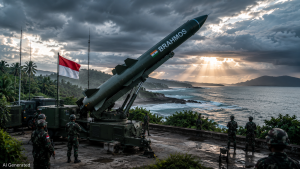
While official joint statements keeps things diplomatic, sources say Indonesia has purchased a lethal coastal defense configuration. Indonesia is acquiring land-based mobile anti-ship batteries of the BrahMos supersonic cruise missile. Traveling at Mach 2.8, these cruise missiles fly so fast and so low that they can completely evade modern warship radar until it is far too late.
According to Reuters, the contract signed between Brahmos and Indonesia’s Ministry of Defence is worth about US$630 million, including: BrahMos missile system, infrastructure, training, maintenance, technical support, phased capability expansion.
But today’s deal of one Brahmos battery struck a twist. The July 7th deal holds a massive surprise. Indonesia isn’t just securing its coasts; it’s securing its skies. Jakarta is also procuring India’s indigenous Astra mk1 Beyond-Visual-Range Air-to-Air Missiles.
The Indonesian Air Force operates Russian-made Sukhoi fighter jets Su-27 and Su-30s. Because India’s DRDO has already mastered integrating both BrahMos and Astra missiles onto Sukhoi platforms, Indonesia gets a plug-and-play deadly weapon system without needing Western or Chinese approval.
To understand how significant the India Indonesia cooperation is, we have to look back. Indonesia is now the third major export customer for the BrahMos, following the historic 2022 deal with the Philippines and a subsequent agreement with Vietnam.
Due to its crucial Geography, Indonesian military planners are moving toward an aggressive Anti-Access/Area Denial framework. This strategy assumes significance due to China’s aggressive posture, expansionist nature and adamant enforcement of its imaginary illegal nine dash line.
Previously, the Indonesian Navy successfully tested Russian-made Yakhont supersonic missiles—the very platform BrahMos was developed from. But those older systems faded out of operational status. Today’s deal replaces them with a modern, continuously upgraded network.
In July 2020, then Indonesian Defence Minister Prabowo Subianto raised the possibility of acquiring BrahMos during talks with India’s Defence Minister. This marked the beginning of formal discussions. By 2023, BrahMos Aerospace confirmed it was in advanced negotiations with Indonesia.
On 9 March 2026, Indonesia’s Defence Ministry announced that it had entered into an agreement to procure the BrahMos missile system. Officials said the first phase would procure one coastal-defence battery, with additional phases planned later. Now we see the the final contract signing during PM Modi’s visit.
By placing BrahMos mobile batteries along its Archipelagic Sea Lanes, Indonesia can single-handedly close down or defend key maritime chokepoints—including the strategically vital Strait of Malacca. Now lets talk the development Vis-à-Vis China – The Ring of Fire.

For years, China’s expansive Nine-Dash Line claim has encroached directly onto Indonesia’s Exclusive Economic Zone around the gas-rich Natuna Islands. Chinese maritime militia and coast guard vessels have consistently tested Jakarta’s patience.
Until now, Southeast Asian nations faced an asymmetrical threat from the massive Chinese People’s Liberation Army Navy. But India’s export strategy changes the calculus entirely.
Think about it. Vietnam has the Bastion systems and is eyeing BrahMos. The Philippines has positioned its BrahMos batteries facing the West Philippine Sea. And today, Indonesia secures the southern flank.
India is effectively arming a “Ring of Fire” around the South China Sea. If a conflict breaks out, any hostile navy attempting to traverse these waters will be staring down the barrels of supersonic missiles owned by nations that refuse to be bullied.
Beyond the Missiles – The Greater Partnership
July 7th breakthrough goes deeper than hardware. Sometimes, the most important strategic victories are not won with missiles or aircraft carriers. They are won with ports. Alongside the missiles, New Delhi and Jakarta finalized a joint framework to develop Sabang Port—a deeply strategic harbor overlooking the entrance to the Strait of Malacca. Add to that new agreements on critical minerals like nickel, rare earth magnets, and steel supply chains, and it becomes clear: India and Indonesia are tying their geopolitical fates together.
As Prime Minister Modi noted in Jakarta, in an era of global turmoil, the role of reliable partnerships is more vital than ever. A small Indonesian port on Weh Island in Aceh Province, is situated at one of the world’s most important maritime chokepoints— the Strait of Malacca, through which roughly a quarter of global trade and a large share of China’s imported oil flows.
The message from Jakarta today is crystal clear. The Indo-Pacific is no longer a playground for a single dominant power. The rules of the game have just changed. Many believe Sabang became important only after China expanded its naval presence.
In reality, the project dates back to May 2018, when Prime Minister Narendra Modi and Indonesian President Joko Widodo elevated bilateral ties to a Comprehensive Strategic Partnership.
The two leaders established a Joint Task Force to develop port-related infrastructure in and around Sabang. The vision was for cooperation in logistics, maritime connectivity, trade, tourism, and economic development—not the establishment of an Indian naval base.
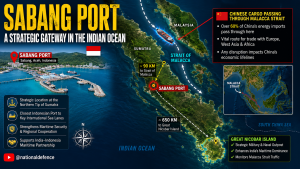
Officially, India and Indonesia never described Sabang as a military project. But strategy is often about potential rather than declarations. From Beijing’s perspective, several developments stood out— India already operates the tri-service Andaman and Nicobar Command. Sabang is geographically close to those islands. China increasingly relies on the Strait of Malacca for energy imports.
The People’s Liberation Army Navy has expanded its presence in the Indian Ocean. Chinese analysts have long discussed the “Malacca Dilemma”—the vulnerability created by dependence on this narrow sea lane for imported energy. India cannot close the Strait, nor has it claimed any intention to do so. However, improved logistics, maritime awareness, and cooperation around Sabang naturally increase India’s understanding of activity near this critical route. That is enough to draw strategic attention in Beijing.
Now connect Sabang with another Indian project. The Great Nicobar transshipment port. India is investing billions of dollars to transform Great Nicobar into a major logistics and maritime hub. Sabang sits only about 100–125 nautical miles away, depending on the route. Together, these projects could create a network improving trade, shipping, maritime awareness, and economic connectivity across the eastern Indian Ocean.
Let’s look at the inside details of what New Delhi and Jakarta just codified. Indonesia holds a staggering 21 percent of the entire world’s verified nickel reserves, alongside massive deposits of bauxite and copper.
But Jakarta has banned the export of raw ore; they want high-value processing done on their soil. India just stepped up to the plate with three specific, high-impact countermoves:
India’s Midwest mining firm and Indonesia’s newly formed state giant, Perusahaan Mineral Nasional (Perminas), signed a pact to develop an advanced development center for non-ferrous metals.
The Ultimate Weapon is Rare Earth Magnets. Crucially, the two nations finalized an industrial partnership to manufacture rare-earth permanent magnets. These aren’t refrigerator magnets—these are highly specialized, ultra-powerful components essential for electric vehicle motors, wind turbines, and guided missile navigation systems.
To understand why this has infuriated policymakers in Beijing, you have to look at how China weaponized the market.
For the past decade, China essentially controlled the global transition to clean energy. They didn’t just mine minerals; they monopolized the refining and processing. If New Delhi wanted to build EVs, solar panels, or advanced electronics, the supply chain almost always bled through Chinese hands.
By shifting processing out of China and setting up joint manufacturing hubs in Indonesia, India is bypassing the Chinese gateway completely. The timing of this mineral deal is brilliant. It isn’t happening in isolation. Look at the broader picture signed alongside these minerals on 7th July. Besides Beijing there is also a message to US that has dropped Indo from its USINDOPACOM Command and reversed it to USPACOM. India is pursuing its own Indo- Pacific policy with reliable partners.
With the integration of India’s UPI payment system into Indonesia, the upcoming Preferential Trade Agreement, and these deep mineral tie-ups, the economic center of gravity in Asia is shifting. Southeast Asian nations are realizing they no longer have to choose between Western dependence or Chinese coercion. There is a third way.
The message from Jakarta today is clear— The minerals that will power the next century will no longer be mined, refined, and weaponized by a single superpower. The supply chain has just been broken wide open. A greater focus and strengthening partnership with ASEAN Nation is India’s calibrated strategy at a time when the Global South is looking at India eagerly joining the UN Security Council as permanent member and Indonesia is one big supporter of India.
#IndiaIndonesiaDefenceDeals, #Brahmos, #AirToAirMissile, #SouthChinaSea, #RingofFire, #PMModiIndonesiaVisit
About the author: Shailesh Kumar is an independent investigative freelance journalist and founder Editor of “National Defence. He has been reporting for India’s top and leading news television, newspapers and digital / web media for about 25 years.
Comments