
Are India’s students being turned into cannon fodder for political battles? Thousands of students have genuine concerns about their future. Their voices deserve to be heard. But an important question remains: Did some politicians or political parties try to cash in on those emotions? Was the CJP protest merely a spontaneous student movement, or was there a larger political objective behind it? Was Abhijit Dipke simply the public face of the movement, or were others influencing events behind the scenes? National Defence examines the available evidence, connects the dots, and asks the questions many have ignored. No propaganda. No shouting. No preconceived conclusions. Only facts, evidence, and fearless journalism. Because truth must prevail.

Shailesh Kumar, National Defence
New Delhi, 23 July 2026
Every movement has a beginning. But not every beginning explains why millions choose to follow.
For Akanksha Chaturvedi, NEET wasn’t just an examination. It was the doorway to a dream. On 3rd May 2026, she was among nearly 22 lakh students who appeared for the National Eligibility cum Entrance Test (NEET-UG), hoping to secure a medical seat somewhere in India.

Like millions of young Indians, 18-year-old Akanksha dreamed of becoming a doctor. After the examination, she called home. She sounded relieved. Happy. Confident. She believed she had done well.
Then everything changed. On 12th May, television channels, social media, and newspapers were flooded with reports that NEET-UG 2026 had been cancelled following allegations of a paper leak.
For lakhs of students, it meant uncertainty. For Akanksha, according to her family, it marked a profound change.
Just eight days later, on 20th May, she was found dead at her family’s home in Nagpur.
Her father, Krishna Kumar Chaturvedi, worked as a cook. Despite limited means, the family had poured everything they had into their daughter’s education—borrowing money from relatives, taking loans, and sacrificing for years so she could chase her dream of wearing a doctor’s white coat.
Speaking to the media, her father reportedly said that he noticed a drastic change in Akanksha’s behaviour after the examination was cancelled. Then came the discovery that shattered the family forever. A few days later, they found a handwritten note that reads and I quote
 “Mom and Dad, you had faith that your daughter would study hard and become a doctor, but I no longer have the courage to take the NEET exam again.” “I would have scored good marks in my first attempt, but now there is no guarantee that I will perform well again. I am sorry, Mom and Dad. I have ruined everything.” Akanksha Chaturvedi who dreamt of healing the wounds of patients had just left behind a void, agony and never ending pain for her family.
But unfortunately Akanksha dying by suicide was not alone. For the 2026 NEET cancellation and re-test, there were reportedly at least 12 student suicides in the 37 days between the cancellation of NEET and the re-examination. These were real identified cases across multiple states, reconstructed through families and investigators.
Think of the hard work, perseverance and patience of students spending years preparing for a single examination.
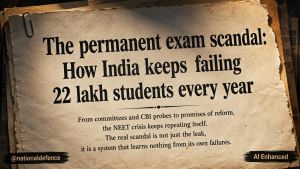 A media investigation identified 45 major examination paper leak cases between 2002 and 2025, each involving examinations with more than one lakh candidates. Collectively, these breaches disrupted the careers of over 3.86 crore aspirants competing for government jobs, university admissions, and professional qualifications.
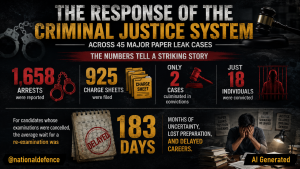
The response of the criminal justice system tells a striking story. Across these 45 cases, 1,658 arrests were reported and 925 charge sheets were filed. Yet media records indicate that only two cases culminated in convictions, with just 18 individuals convicted. For candidates whose examinations were cancelled, the average wait for a re-examination was 183 days—months of uncertainty, lost preparation, and delayed careers.
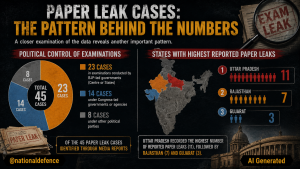
 A closer examination of the data reveals another important pattern. Of the 45 paper leak cases identified through media reports, 23 occurred in examinations conduct ed by governments led by the BJP at the Centre or in the states, 14 were under Congress-led governments or agencies, while the remaining cases occurred under governments led by other political parties. Uttar Pradesh recorded the highest number of reported paper leaks (11), followed by Rajasthan (7) and Gujarat (3).
These figures reflect where the reported incidents occurred—not the political responsibility or culpability of any party. They nevertheless underscore that the paper leak crisis has spanned governments of different political affiliations and persisted across more than two decades, while convictions have remained exceptionally rare.
 The NEET-UG 2024 investigation exposed what investigators described as an organised paper leak network—brokers, middlemen, safe houses, and candidates allegedly paying tens of lakhs of rupees for advance access to question papers.
It was not an isolated failure. Repeated examination irregularities have disrupted the futures of millions of aspirants, raising serious questions about the credibility of India’s public examination system.
Governments responded with arrests, CBI investigations, and tougher anti-paper-leak laws. But for many students, one question remained unanswered:
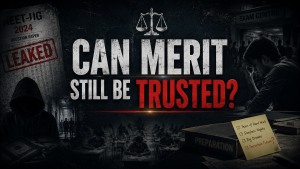 Can merit still be trusted?
That question—and the anger it fueled—became the spark behind the CJP movement. But the big question is was it a spontaneous movement or was it planned with pre-conceived political goals cashing on the emotions of innocent and gullible young children.
Were children used as a canon fodder to political battles as they draw emotions of parents, teachers and the society at large? National Defence Reporter Shailesh Kumar brings to fore the deep buried facts and pieces of puzzle crosswords that will solve the enigma of whole story and will make the picture crystal clear showing how dirty has become the Indian politics.
On 15th May, Chief Justice of India Surya Kant hearing regarding the designation of senior advocates and concerns over individuals entering the legal profession dropped words that created a cascading social ripples:
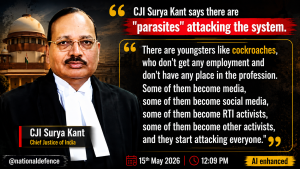 “There are youngsters like cockroaches, who don’t get any employment and don’t have any place in the profession. Some of them become media, some of them become social media, some of them become RTI activists, some of them become other activists, and they start attacking everyone.” – CJI.” (LIVE LAW). This was posted by Live Law on its Twitter handle at 12:09 PM on 15th May. The tweet went viral and received almost 2 million views till now.
Millions of young Indians – struggling with jobs, exam scams like NEET, and daily frustrations – felt personally attacked. Within hours, the internet exploded.
The CJI quickly clarified. Media reported quoting him that his words were aimed ONLY at people with fake degrees and bad intentions – NOT the entire youth of India. He called real youngsters “pillars of a developed India.” Many praised the clarification. Others said the damage was already done.
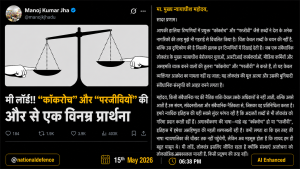
RJD MP Manoj Kumar Jha wrote a detailed Hindi response to CJI’s comments at 06:38 PM that was later reposted by Supreme Court Advocate Prashant Bhushan.
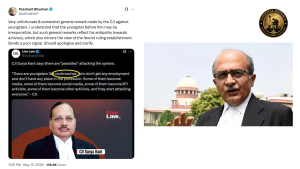
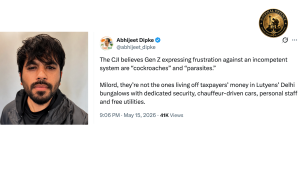
Abhijit Dipke reacted on CJI’s Cockroach comments on Twitter now X at 09:06 PM IST on May 15 barely 2 hours later Prashant Bhushan first tweeted at 7 pm IST marking “Cockroach” in a circle on Live Law tweet snippet. The Boston time of tweet will be 11:36 AM on May 15. Abhijit Dipke wrote in tweet and I quote,
 “The CJI believes Gen Z expressing frustration against an incompetent system are “cockroaches” and “parasites.” “Milord, they’re not the ones living off taxpayers’ money in Lutyens’ Delhi bungalows with dedicated security, chauffeur-driven cars, personal staff and free utilities”.
Incidently Abhijit Dipke’s tweet got only 41K views till now with 2.7K like, and 21 comments and 677 retweets. Whereas Prashant Bhushan’s tweet got around 136K views, 11K likes and 3.7 retweets and 623 comments much higher than Dipke’s.
Abhijit Dipke launched cockroach janta party campaign at 11:30 AM on May 16 Indian Standards Time on Twitter when it is 01:30 AM on May 16 in Boston, USA.
 He also gave google form link on twitter post. Barely 2 hours before launch of the campaign, there was another big move by Abhijit Dipke that may further indicate Cockroach Janta Party was a result of a pre-planned political move. CJP website COCKROACHJANTAPARTY.COM was registered at 09: 22 PM on 16th May.
Though Advocate Prashant Bhushan, founding member of AAP Party was expelled from AAP Party in April 2015 due to internal disagreements and public criticism of party leadership. However, a glance at his twitter history suggests he actively supported CJP movement.
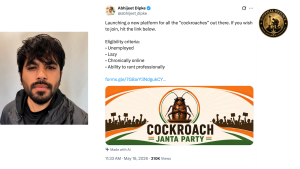
Abhijit Dipke has not hidden his links with the AAP Party. He acknowledged he previously worked with AAP Party in various interviews. However he publically denied he is presently working with AAP Party.
Dipke used to carry out communications work in the Delhi Chief Minister’s Office, communications work connected with the Delhi Education Department and digital/social media work during AAP’s campaigns.
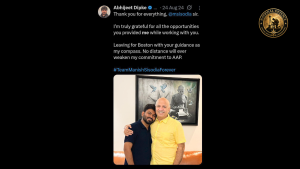
Interestingly, before leaving for Boston Dipke thanked Manish Sisodia and Aatishi and I quote. “Thank you for everything… Leaving for Boston with your guidance as my compass. No distance will ever weaken my commitment to AAP.”
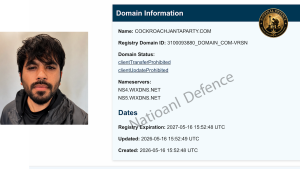 Dipke has publicly denied that CJP is operating on behalf of AAP. However, his own tweets tale a different story.
Interestingly, from 11th May onwards, AAP leader Arvind Kejriwal started taking increased interest in paper leak cases. On 12th May he wrote on AAP twitter and I quote, “The NEET exams are leaking for the fourth time. Why hasn’t anyone been punished yet? Is it possible for leaks to happen repeatedly without government protection?”
On 13th May, Kejriwal again tweeted with a call to GenZ to raise for the movement. He wrote and I quote, “Wake up, Gen-Z, wake up. Rise and fight. Share this video with as many people as possible and discuss it”.
On 13th May, Abhijit Dipke replies to tweets of his associate Amit Kilhor saying “maybe fix your own algorithm first? Instagram feeds you the kind of content you engage with”. But Amit Kilhor’s tweet was deleted for some reasons. https://x.com/amitkilhor/sta/amitkilhor/status/2054217549517340970
 A few hours later on 13th May itself Abhijit Dipke again tweets and this time he directly asks GenZ of what they think of Modi Government. I quote his tweet, “What does the average Gen Z think about the Modi govt?Are you frustrated or concerned about what’s been going on in the country lately?”
So this was the direct call for invoking GenZ into something that later became Cockroach Janta Party.
On 14th May Kejriwal again tweeted, “The suicide by a 17-year old student in Goa due to cancellation of the NEET exam is heartbreaking. Who is responsible for the loss of this young life? Will action be taken against those at the top, who are the ones actually responsible for this paper leak? I will be meeting the grieving family shortly, to express my condolences on this irreparable loss and stand with them in this difficult time”.
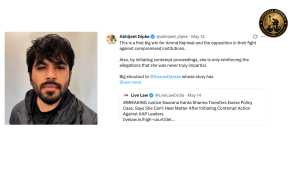 CJP founder Abhijit Dipke on 14th May even tweeted that established his close association with AAP founder Arvind Kejriwal.
“This is a first big win for Arvind Kejriwal and the opposition in their fight against compromised institutions. Also, by initiating contempt proceedings, she is only reinforcing the allegations that she was never truly impartial.
Big shoutout to @SauravDassss whose story has made all the difference. Great work brother!”
Saurav Dass is none but a young journalist who became the spokesperson of Cockroch Janta Party. He has publicly posted soliciting contributions from public via a razorpay account for his active journalism asking for Rs 5000 from partners and Rs 10000 from patrons.
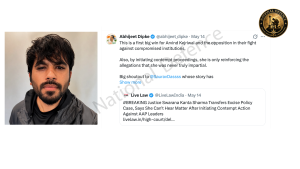 The story Abhijit Dipke was siting was on Justice Swarana Kanta Sharma Transferring Excise Policy Case Saying She Can’t Hear Matter After Initiating Contempt Action Against AAP Leaders. Abhijit Dipke posted the tweet at: 09:13 PM on 14th May just a day before he posted Cockroach tweet. Saurav Dass Acknowledged his gesture by folded hands symbol on twitter.
Not only this Abhijit Dipke’s tweet on the very same say of CJI’s remarks itself established that Dipke, Ashutosh Ranka , AAP and Rahul Gandhi were in sync with each other on paper leak issue and were working actively. He wrote while requoting Rahul Gandhi’s tweet on paper leak. At 4:33 PM on 15th May when CJI made cockroach remarks, Rahul Gandhi wrote and I quote,
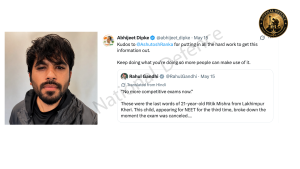 “No more competitive exams now.” These were the last words of 21-year-old Ritik Mishra from Lakhimpur Kheri. This child, appearing for NEET for the third time, broke down the moment the exam was canceled.
In Goa too, a NEET aspirant took his own life.
These children didn’t lose to the exam—they were killed by a corrupt system. This isn’t suicide—it’s murder by the system. Look at the numbers: From 2015 to 2026—148 exam scams. 87 exams canceled, the futures of 9 crore children affected. Out of 148 scams, only 1 resulted in punishment. CBI took up 17 cases, ED took 11—no one was punished. In NEET, AIPMT, and other medical exams alone—15 scams.
And the most shameful part: In these scams, not a single officer or minister responsible resigned. They’re removed—then quietly reinstated to higher positions. Those who orchestrate the theft get rewarded, while the children taking the exams lose their lives. Modi ji—how many Ritiks will it take to awaken your accountability?
My young friends, your pain is my pain. Your hard work is my hard work. Those who steal your future will have to answer. No matter how much time it takes, no one will be spared—this is my promise. We will fight this battle together—and we will win”. Unquote.
On this very comment of Congress leader Rahul Gandhi, CJP founder Abhijit Dipke wrote and I quote, “Kudos to @AshutoshRanka for putting in all the hard work to get this information out. Keep doing what you’re doing so more people can make use of it”.
So Abhijit Dipke on 15th May hours before the launch of Cockroach Janta Party congratulating his associate Ashutosh Ranka for a work on paper leak cases that was highlighted by congress leader Rahul Gandhi. Abhijit Dipke himself confirms that AAP, Congress and he while being in Boston were working on the same project.
Interestingly soon after… the very next day Cockroach Janta Party (CJP) was born and got traction, Manish Sisodia on 17th May launched a campaign in Chandigath with AAP Party workers felicitating GenZ. Sisodia went to CJP stage a day after Sonam Wangchuk was forcibly taken to hospital by authorities to save his life. Sisodia in full view acknowledged his association with Dipke and other workers.
CJI was born because of Chief Justice Suryakant’s remarks. However, there is no known link of Abhijit Dipke with CJI Suryakant. For anyone thinking CJI and Prashant Bhushan links with CJI, then they know each other because of professional reasons but personal understanding can not be established by this channel neither the channel intends to cast aspersion on any of them.
Now lets come back to CJI Suryakant’s remarks. What Happened Next? And how did the Supreme Court Reacts.
According to media reports, a lawyers rushed to Chief Justice of India Suryakant with a petition demanding action against the “misuse” of the CJI’s words and the viral campaign Coackroach Janta Party. On 25th May, CJI Surya Kant told the advocate: “Don’t take the ‘Cockroach Janta Party’ issue so sentimentally.” Justice Suryakant reportedly said the court would look into it properly – no urgency needed. Critics call this dismissive. Supporters say people are overreacting to a misunderstood comment.
CJP’s Instagram account was created around 16 May 2026. It reportedly reached about 500,000 followers on Day 1, around 3 million on Day 2, 7 million on Day 3, and 10 million by Day 4, overtaking BJP’s Instagram following.
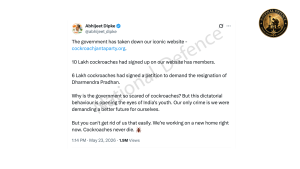 On 23 May at 1:14 PM Abhijit Dipke tweeted that the government has taken down our iconic website – http://cockroachjantaparty.org. 10 Lakh cockroaches had signed up on our website as members. 6 Lakh cockroaches had signed a petition to demand the resignation of Dharmendra Pradhan. Why is the government so scared of cockroaches? But this dictatorial behaviour is opening the eyes of India’s youth. Our only crime is we were demanding a better future for ourselves. But you can’t get rid of us that easily. We’re working on a new home right now. Cockroaches never die. 🪳
Now a website that is registered barely 2 hours before the launch of the campaign getting so much traffic. Now the cost of running such a website built and managed by a competent engineering team could be roughly ₹ 5– 20 lakh initially, with ongoing monthly costs depending on traffic and features. Where did that money come if Abhijit Dipke was operating alone from Boston and had no political and financial backing? The larger unanswered question is how CJP’s system was actually built and operated, because that information has not been publicly disclosed.
Abhijeet Dipke reportedly acknowledged that he comes from a middle-class Dalit family in Chhatrapati Sambhajinagar (formerly Aurangabad), Maharashtra. His Father Bhagwanrao Dipke is a retired Deputy Engineer with the Maharashtra Industrial Development Corporation. He reportedly retired in 2025. His mother Anita Dipke is a homemaker. His elder sister is reported to be based in the United States. Abhijeet studied at Alphonso English School and later S.B. College before pursuing higher education in Pune and then the United States. Abhijit reportedly told media that his family was not rich. He has spoken about growing up in a humble Dalit family where resources were scarce, noting that his family experienced severe financial hardship, such as sharing a single roti or traveling on bullock carts for water during droughts in his grandparents’ village. Now big question is who is funding his education in Boston.
 According to Boston University website, the first-year tuition fee for the Master of Science in Public Relations at Boston University is $66,670 USD, which is approximately ₹66.75 Lakhs, plus an estimated $23,080 USD that comes around ₹22 Lakhs for annual living expenses. The program requires 48 credits (12 courses) across 3 semesters, charged at a rate of $1,250 per credit ($5,000 per course). Besides, there is estimated Health Insurance & Supplies: ₹3.13 Lakhs for insurance and standard student costs. This is all for just one year. Now the cost of running websites, coming back to India leaving his studies, and here flying by air besides lodging and boarding cost. Where is the money coming from?
Remember, before leaving for Boston Dipke thanked Manish Sisodia and Aatishi. “Thank you for everything… Leaving for Boston with your guidance as my compass. No distance will ever weaken my commitment to AAP.”
For AAP Party, CJP is its Nirbhaya movement. In 2012 November, AAP Party was just formed when Nirbhaya was raped that led to the protests belonging to the collective public conscience. As CJP claims over 20 deaths of students due to paper leak justify the demand of Education Minister Dharmendra Pradhan.
The movement got traction and more and more students and Gen Z joining the protest. the CJP protest was not driven solely by one paper leak. It was fuelled by a broader loss of public confidence in the fairness, transparency, and credibility of the examination system—a concern that is rooted in documented events, even though the appropriate political response remained a matter of democratic debate.
In its early phase, the CJP movement focused on the education crisis. CJP demanded the resignation of Union Education Minister Dharmendra Pradhan, comprehensive reforms to the examination system to prevent future paper leaks, timely re-examinations for affected candidates, age relaxation for students who lost opportunities because of repeated cancellations, and financial compensation for students impacted by the examination crisis.
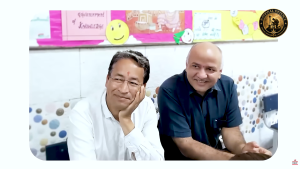 Though Abhijit Dipke became a GenZ face capable to draw youngsters to its fold, the movement still needed a non- political authoritative face to give it more legitimacy. It needed a face that GenZ could easily connect to. Nothing could have been better than 3 Idiot’s character Phunsukh Wangdu or Rancho in film played by Aamir Khan but in real life by so-called Sonam Wangchuk. Manish Sisodia himself acknowledged his long standing association with Sonam Wangchuk and he on multiple times on different public platforms used to talked about Rancho in past.
By late June 2026, Wangchuk began a hunger strike in solidarity with the youth-led movement.
On 9 July, CJP officially announced that it would hold a “Sansad Chalo” (March to Parliament) protest on 20 July 2026, coinciding with the opening of the Monsoon Session of Parliament.
The march was to begin from Jantar Mantar and was announced jointly with activist Sonam Wangchuk, who had already been on an indefinite hunger strike since 28 June.
Meanwhile on 17th July Delhi police commissioner Satish Golcha was removed by Union Home Ministry. On 18th July Anurag Kumar, who earlier served as Special Director in Intelligence Bureau took charge. On 18th July, Delhi Police in a dramatic move removed Sonam Wangchuk from the protest site for hospitalization.
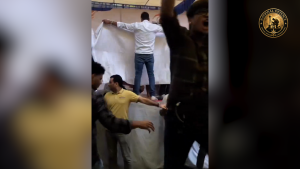 The extraction of Sonam Wangchuk from the protest site attracted huge eyeballs and public outrage. According to sources, Delhi police planned the extraction around 3 am. New Delhi district police personnel were assembled under the pretext of a Parliament security drill. They were then briefed that the actual mission was to remove Sonam Wangchuk from Jantar Mantar, with instructions to complete the extraction in about 30 seconds.
Police waited until early morning, when the protest site had fewer people. Some reports also said they monitored the protesters’ routine and chose a moment when Abhijeet Dipke was briefly away from Wangchuk.
Officers surrounded Wangchuk with large white sheets or a white curtain, blocking the view of supporters and cameras while he was lifted from the stage. A human chain of police was reportedly formed around the area.
Once behind the visual screen, Wangchuk was carried to an ambulance and taken under police escort to Safdarjung Hospital. The transfer took only a few minutes.
Delhi police says it acted on expert medical advice, pursuant to a Delhi High Court direction permitting medical monitoring and intervention if his condition deteriorated, because his prolonged hunger strike posed a serious health risk.
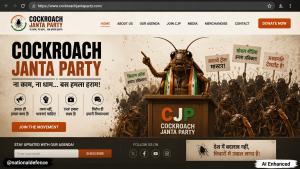 Whereas CJP, opposition, Wangchuk and his supporters claim that he was removed against his wishes, the operation lacked informed consent, and it was intended to weaken the protest before the planned “Sansad Chalo” march. Those are their allegations and became part of subsequent court proceedings.
Now the CJP movement had narrowed its negotiations with the government to three immediate demands.
First, the resignation of Union Education Minister Dharmendra Pradhan, holding him politically accountable for the examination crisis.
Second, the immediate release of Sonam Wangchuk, who had by then become one of the most prominent public faces supporting the movement.
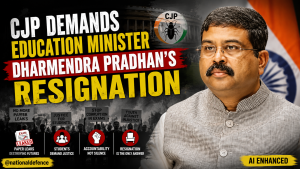 Third, compensation of ₹1 crore to the families of NEET aspirants who allegedly died by suicide following the examination controversy.
However, on 19th July, Delhi police refused permission; CJP reiterated the march will proceed peacefully and issues participant guidelines like “carry the Tiranga and avoid political flags”.
On 20 July: The planned CJP “Sansad Chalo” march took place amid a major police operation.
The big question is: did the CJP Movement Operate Within the Law? Article 19(1)(a) of the Constitution guarantees freedom of speech and expression. Article 19(1)(b) protects the right to assemble peacefully and without arms.
These freedoms form the foundation of democratic protest. But they are not absolute.
The Constitution also permits the State to impose reasonable restrictions in the interests of public order, public safety, the sovereignty and integrity of India, and other legitimate constitutional objectives. The challenge lies in balancing them. That balance became one of the central issues during the CJP movement.
Every permission issued for a large public gathering is normally accompanied by conditions designed to protect both public safety and the rights of others. These may include restrictions on the approved route, timing, number of participants, use of loudspeakers, access to restricted areas, traffic management, and security arrangements.
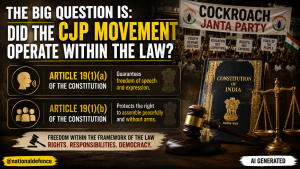 The march toward Parliament was not authorized. Delhi Police publicly stated that no permission had been sought or granted for the proposed march on 20th July. The march would therefore be treated as unauthorized, restrictions under Section 163 of the Bharatiya Nagarik Suraksha Sanhita (BNSS) were imposed in parts of New Delhi because Parliament was in session, police said they would not allow the procession to enter the high-security Parliament area.
That does not mean protesting itself was illegal. It means the specific procession to Parliament, in the circumstances and location, lacked police authorization according to the authorities.
Before the march- CJP leaders repeatedly appealed for supporters to remain peaceful. Abhijeet Dipke described it as a peaceful Parliament march. Sonam Wangchuk’s message, conveyed through his wife, urged protesters to keep the protest peaceful and not let it be misused.
During the march- Violent clashes occurred. According to Delhi Police- protesters attempted to breach barricades, there was alleged stone-pelting, vehicles were damaged, multiple FIRs were registered over violence and vandalism.
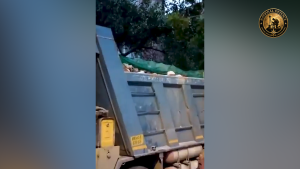 According to CJP: police used excessive force, protesters were subjected to lathi charges, there were allegations of brutality and unlawful detention, Abhijit Dipke & other CJP leaders also reportedly pointed out the presence of a truckload C&D waste at protest site, where a building was under construction alleging conspiracy. Police however denied allegations such as the use of pellet guns.
As the CJP protests grew, several opposition political leaders publicly supported the movement, and some physically joined the protest at Jantar Mantar. It is useful to distinguish between those who attended the protest and those who expressed political support.
On 20th July, during Sansad Chalo protest violence and aftermath, Rahul Gandhi and Priyanka Gandhi kept silence and Priyanka Gandhi later in the day made a statement asking Prime Minister to listen to students demand and meet them but a day later on 21st July, Rahul Gandhi visited the protest site, joined demonstrators, and was later detained by Delhi Police during the protests near gates of PM Modi’s residence from where his cavalcade passes. However Rahul Gandhi, Priyanka Gandjhi, and Akhilesh Yadav were later released after brief detention.
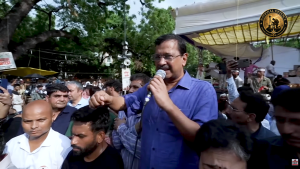 Manish Sisodia, former Education Minister in AAP’s Delhi Government joined the protest on 20th July at Jantar Mantar after crossing police barricades.
Atishi, former Delhi CM also crossed barricades to join the protesters. Sanjay Singh joined the protest alongside other AAP leaders
How Did the Police Respond? As protesters attempted to advance toward restricted areas in Delhi, the police responded with barricades, traffic diversions, restrictions on movement, detentions, and crowd-control measures. According to the authorities, these actions were necessary to prevent disorder, protect public property, and maintain security in the national capital.
The organisers present a different account. They argue that peaceful demonstrators were prevented from exercising their constitutional right to assemble and allege that the police response became unnecessarily forceful. These competing narratives frame one of the most difficult questions in democratic policing.
The police are expected to protect both public order and constitutional freedoms at the same time. Sometimes those responsibilities reinforce one another. Sometimes they come into conflict.
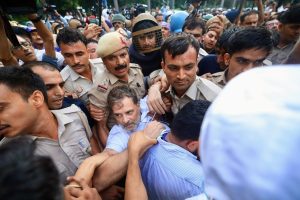
Whether the police response in this case remained lawful, necessary, and proportionate depends not on political opinion but on evidence. That evidence includes police orders, operational records, video footage, eyewitness testimony, medical reports, and the legal standards developed by Indian courts regarding the use of force during public assemblies.
However, as of the latest publicly available information, there has been no announcement of a judicial commission, SIT or independent inquiry specifically into the violence during the 20 July 2026 “Sansad Chalo” protest.
Cockroach Janta Party (CJP) founder Abhijeet Dipke led and participated alongside supporters and protesters heading toward the Parliament complex from Jantar Mantar. As the crowds pushed forward amidst clashes and heavy security, Dipke was picked up and detained by the Delhi Police. While the march and detentions were underway, CJP spokespersons Saurav Das and Ashutosh Ranka left the protest site to represent the group.
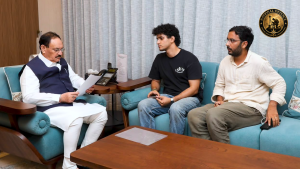 This designated delegation met twice with Union Minister JP Nadda at his residence to submit a memorandum of demands, while Dipke remained associated with the frontline agitation and subsequent sit-ins.
Delhi Police said protesters breached barricades, leading to clashes in which 118 police personnel and 60 protesters were injured. Delhi Police registered six FIRs in connection with the violence under charges of assault on police personnel; stone-pelting; breach of security barricades; damage to public and police property; obstruction of public servants while performing official duties; and rioting and disturbance of public order.
These FIRs reportedly were registered primarily against unidentified individuals, not against the CJP organisation as a whole. There may be more FIRs in offing. Equally significant, there is no publicly available evidence that the FIRs name Abhijeet Dipke, Sonam Wangchuk, or the senior leadership of the movement as accused persons. Instead, investigators stated that responsibility would be determined through evidence.
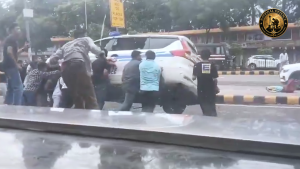 The Delhi Police announced that they were examining CCTV footage, media recordings, mobile phone videos, and other digital evidence to identify specific individuals allegedly involved in acts of violence.
Prominent leaders like Rahul Gandhi, Priyanka or Akhilesh did not speak much on Sansad Chalo protest march day. However, by 21 July, the student agitation had moved far beyond mere as a student’s protest.
What had begun as a movement over paper leaks had become a national political flashpoint.
 Senior opposition leaders—including Rahul Gandhi, Priyanka Gandhi Vadra, and Akhilesh Yadav—joined protests in Delhi, demanding accountability over the handling of the examination crisis and the police action against student demonstrators. As they attempted to stage a protest near the Prime Minister’s residence, they were detained by Delhi Police.
The images dominated television screens, newspaper front pages, and social media timelines across the country. What had started as a student movement was now the country’s biggest political story.
Supporters described the opposition’s participation as solidarity with aggrieved students.
The movement had entered a new phase—one in which student grievances had become the centrepiece of a larger political confrontation between the Opposition and the government.
Whether this political escalation was an inevitable consequence of a nationwide student movement—or whether it had become the objective of some participants—is one of the central questions this investigation examines.
Now comes the big question, is union education minister Dharmendra Pradhan responsible actually for all the paper leaks? There is no evidence that Union Education Minister Dharmendra Pradhan is personally responsible for every paper leak. To establish criminal responsibility, there would need to be evidence that Pradhan: ordered a paper leak, participated in one, protected the perpetrators, or was part of a conspiracy.
The investigations into paper leaks have instead targeted alleged leak networks, middlemen, coaching operators, and other individuals. In the recent NEET case, arrests were made in connection with the alleged leak, not of the minister.
The Ministry of Education oversees the National Testing Agency (NTA), which conducts exams such as NEET, JEE, and CUET.
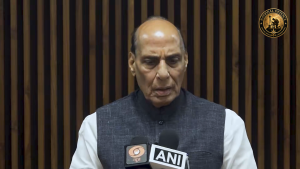 As minister, Dharmendra Pradhan has political and administrative responsibility for the ministry’s functioning, even though the NTA is an autonomous agency under the ministry. After the 2024 controversies, he announced reforms, constituted a high-level committee led by former ISRO chairman K. Radhakrishnan, and later restructured the NTA’s role. CJP and opposition parties are asking for political accountability.
The government has taken the opposite position. It argues that: criminal networks were responsible for the leaks, investigations and arrests have been carried out, reforms have been initiated, and therefore resignation is not warranted.
Now a specific question if Dharmedra Pradhan is responsible for “all” paper leaks? Paper leaks have occurred under different central and state governments, involving recruitment exams, university exams, state public service commissions, and school boards over many years. They are typically investigated as criminal conspiracies involving multiple actors rather than being attributed to a single minister.
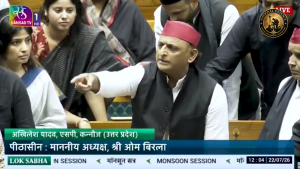 Dharmendra Pradhan may not have personally been responsible for paper leaks. However, as Union Education Minister, he bears political and administrative responsibility for the performance of the examination system under his ministry.
Whether that responsibility should require his resignation is a political judgment rather than a factual conclusion.
And the Government response in dealing with protestors has indicated that Modi Government not going to buzz against protestors demand rather it is determined to deal with protestors and opposition with firm hand.
However, police and RPF action gave opposition parties enough traction to garner GenG support via police high handedness videos projecting Modi Government as Anti- GenZ and creating an emotional connect with a large section of Indian population that may impinge on PM Modi’s popularity.
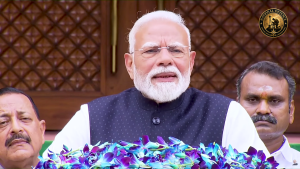
In days to come PM Modi’s social media may likely to witness a negative growth as Rahul Gandhi and Kejriwals social media likely to swell with more followers. But the big question remains- are our children been used as a political bait to regain lost political territories. Are they being used as canon fodder in political battle that is resulting in nothing but dirt and dust. Who is really responsibl
e for injuries to 180 people including 118 police and security personnel and about 60 protesters during the violent clashes owing to CJP protest.
About the author: Shailesh Kumar is an independent investigative freelance journalist and founder Editor of “National Defence. He has been reporting for India’s top and leading news television, newspapers and digital / web media for about 25 years.
Comments